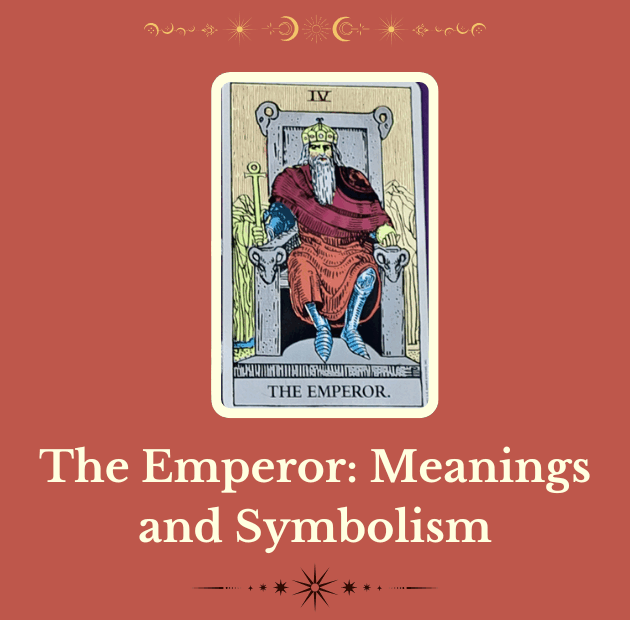
The Emperor is the first masculine ruler of the tarot and placed as Key IV in the Major Arcana. He represents all things business success, worldly power, and stability. Where The Empress rules over all things creative and feminine, the Emperor embodies the more pragmatic financial, career, and traditional male attributes of life.
He is the boss, father figure, and mentor.
Often The Emperor appears to speak about authority, either your own or in your relationship to authority figures in your life. He’s less about the creation of new endeavors and more closely associated with the day-to-day hard work in bringing forward success and financial gain, especially in business strategy and leadership. The Emperor also indicates traditional power structures––the hierarchy in work settings, police and legal authority, and parental figures at home.
In this post, we’ll talk about the meaning of The Emperor in tarot, walk through the symbolism of the card, and discuss different ways to interpret the card when it appears in a spread.
Just looking for the meaning of the Emperor to do a reading? Jump down to “The Meaning of the Emperor in Tarot” section to find out how to read the card upright and reversed. And, if you’re looking for brief definitions for all the cards, check out our Tarot Card Meanings Resource Page.
The Emperor Imagery
The Emperor sits in the foreground, on a sturdy throne. His image takes up the majority of the card design, with very little of the background visible. The throne itself looks to be made of stone, with four rams heads, one on each corner of the back of the throne, as well as the armrests.
He holds his scepter in his right hand and, while we see a lot of scepters in the tarot, the Emperor is the only character who carries scepter with topped with the Ankh, an Egyptian symbol representing eternal life. In his right hand, he holds an orb.
Depicted with a long flowing beard and white hair, he wears a gold crown and red robes over his armor. In the background we see a mountain range.
The Emperor Symbolism Explained
To understand the card better, let’s look into the symbolism. Here are some of the key things to note:
- The Key (IV). The fourth card in the Major Arcana, the Emperor is key number 4. Four represents stability, security, and leadership in numerology.
- The Throne. The throne (made of stone) indicates strength and stability. The fact that he sits on a throne at all symbolizes his role as a ruler and authority figure.
- Rams. The throne features the heads of four (4) rams. Four represents stability and leadership. The ram is also the symbol for Aries, the astrology sign ruled by the god of war and noted for courage and ambition. The ram can also correspond to masculine energy.
- The Emperor’s Scepter. He holds his scepter in his right hand, which represents the more logical side of the brain, ruled by practicality. He is business oriented, rather than emotional or creative.
- The Orb. In his left hand, the creative and intuitive side of his brain, he holds an orb which represents the world or his own dominion over his world.
- Armor. He wears armor, signaling his strength and power.
- Red. His cloak is red, the color of authority (think of the businessman or politician wearing a red power tie).
- Crown. Like the throne, the crown shows his authority and rulership. It’s closed at the top, covering his whole head. He has a high sense of authority and can be self-made or self-sufficient.
- The Emperor’s Appearance. He’s often depicted as mature in years, with a white flowing beard and white hair. This indicates wisdom and the advanced knowledge of a mentor or expert.
- The Mountains. Mountains symbolize challenges to overcome.
- The River. In the background, we get a small glimpse of a river running through. It represents intuition and emotional intelligence.
- The Background. In the Rider deck, the background is yellow with red lines, making it look almost orange, combining both new beginnings and power/passion.
The Meaning of the Emperor in Tarot
The Emperor Upright:
When the Emperor appears in a reading, he often symbolizes an authority figure; a boss, teacher, father, or father- figure. Where the Empress represents creativity, emotions and new beginnings, The Emperor is all about intellectual and business pursuits.
He’s grounded, stable, and decisive. The Emperor takes action and understands how to move through the traditional world, in business, finance, and law. In an upright position, look for career and financial opportunities and ways in which you can grow your own authority.
The Emperor can also appear as a sign of your own confidence and tell you to embrace your role as a leader. This card can also indicate government authority and may indicate a court case or ruling will go in your favor.
As a person, this card represents a man who exudes authority; someone you’d trust to make decisions and take charge of a situation. He is often in a position of authority as well, such as a boss, father, older male family member, or someone you would seek guidance from, such as a mentor or teacher.
When he represents the querent, the message is about cultivating or wielding those characteristics of leadership and authority.
The Emperor Tarot Card Reversed:
In the reversed position, the Emperor can be domineering, micromanaging, and abuse positions of control. He’s synonymous with terrible bosses and tyrants.
Where you pull a reversed Emperor in a reading, look for negative judgment from an authority figure or an unfairness in how someone in power treats you. Or it may be a warning that you yourself are treating others unfairly.
Toxic work environments, difficult relationships with male authority figures, and the danger of getting bullied or caving to domineering authority figures. Can also indicate poor planning in business or listening to bad advice.
As a person, the Emperor reversed lacks character. He may cheat or use unethical business practices and leverages his authority (or perceived authority) to get his way. Not to be trusted.
Ready to Learn More About Working with Tarot?
With 78 cards and loads of resources, learning tarot can be a lifelong journey. No matter how much you know, there’s always more to explore. If you’re looking for more resources to get to know your cards, check out our posts on bonding with your deck, tarot accessories, and getting over Imposter Syndrome.
Interested in more posts like this one? Stop by our posts on The High Priestess, The Fool, The Magician, and The Empress.