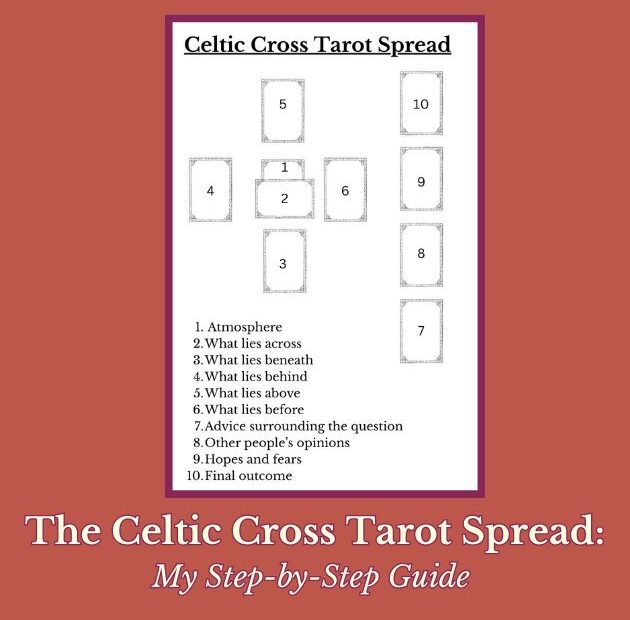
Even if you’ve never picked up a tarot deck, you’ve probably seen the Celtic cross tarot spread. It’s the most famous (and commonly used) layout.
Think of a movie or t.v. show that features a tarot reading and you’ll probably see the cards arranged in a Celtic cross. One example that comes to mind is Mad Men. And that’s a great rabbit hole to jump down; lots of people have discussed how the reading mirrors the arc of the series.
So what is a Celtic cross? Why is the reading called that? Why is it so frigging popular? And most importantly, how do you use the layout? Let’s dive in.
If you paged up this post because you’re doing your first Celtic cross reading, feel free to use my Tarot Card Meanings Resource Page to help interpret the cards.
Want to skip all the background stuff and get right to how to work with the Celtic cross spread? Jump down to the Celtic cross tarot spread positions and meanings.
What is a Celtic Cross (in tarot)?
The Celtic cross spread became popular for one simple reason – it’s the layout A.E. Waite included in his book, A Pictorial Key to the Tarot, published in 1911. If Waite sounds familiar to you, he’s the same guy from the Rider-Waite tarot deck.
So this layout is featured in pretty much every guidebook that accompanies Rider tarot decks. I know it was in my first tarot book.
According to Waite, the Celtic cross was based on a cartomancy spread used by ancient Celts. Though a lot of people have speculated that he invented the layout and basically made up the “ancient” story to give his book a little more hype. You know, old-timey Pagan PR.
Regardless of whether he made it up (hell, he designed the deck most people use today), it’s a good spread for a well-rounded reading.
And, while a lot of people use the Celtic cross layout, you’ll find that there are multiple versions of it. The cards are placed in the same positions, but the meanings assigned to the cards vary. And in some cases, the reader may lay the cards down in a different order from Waite’s original diagram.
If you compare Waite’s diagram to my own, you’ll see that they are not identical.
My Process for the Celtic Cross Tarot Spread
The Celtic cross layout was the very first spread I learned. And many moons later, it’s still my favorite.
It gives you enough information for a detailed, full-pictured reading. At the same time, the Celtic cross is straightforward, so it’s not too difficult to understand or master.
The best of both worlds. It gives you much more insight than a three or five card pull.
Over the years, I’ve fine-tuned what each of the positions means.
Laying the cross section of the spread down clockwise works best for me. It makes the readings more accurate and helps me tune in better.
It also makes more sense to me than Waite’s original order. And you’ll find a lot of other readers use clockwise, as well.
Choosing the significator card
Let’s start at the beginning: the significator card. It’s not listed on my Celtic cross diagram, but I use a significator in most first-time readings.
And I will sometimes pull a new significator card for someone when their energy has changed or they’re at a new place in their life (significator cards aren’t always static).
You have three options:
- Manually sift through the deck and choose a significator card to represent the querent
- Let the cards choose the significator card by drawing a random pull
- Skip the significator card and get on with the reading
I’m in the first camp: intentionally choosing the card by hand. And it’s outside of the 10 cards in the spread (kind of an extra bonus card).
In a layout, I would place the significator in the center of the tarot cloth before anything else (asking questions, shuffling, or cutting the cards).
The significator card represents the querent. It’s about tuning into their energy.
And querents really like them, because it gives them more information about where they are now/what energy is strong/how I’m reading them.
For instance, for most of my life, my significator card has been the Queen of Swords. And I identify with it, the same way you might identify with your astrological sign.
Some readers let the deck choose the significator with a random draw. Other readers don’t use a significator card at all. The choice is really yours.
Okay, let’s get to doing the actual reading!
The Celtic cross tarot spread (positions and meanings)
The order, position, and meaning of the cards:
The Cross
- Position 1: The atmosphere surrounding the question
- Position 2: What lies across
- Position 3: What lies beneath
- Position 4: What lies behind
- Position 5: What lies above
- Position 6: What lies before
The Staff
- Position 7: Advice surrounding the question
- Position 8: Other people’s opinions
- Position 9: Hopes and fears
- Position 10: Final outcome
Position 1: The atmosphere surrounding the question
The first card tells you about the question asked. It, combined with the other cards in the layout, will often show you exactly what area of life the reading refers to — career, love, family, finances, etc.
The atmosphere card gives you clues as to the most important aspect of this question for the querent.
Position 2: What lies across
What lies across (or what covers him) is the card laid sideways over the atmosphere card. This card shows you the opposing forces. What challenges they face, what obstacles might be in their way, and in some cases, who is working against them.
Position 3: What lies beneath
The card at the bottom of the cross is what lies beneath him. I like to think of this as the prologue card.
This is everything in the querent’s experience that informs their perspective. It might be past trauma they’re bringing into the atmosphere, or their past relationship with the people involved in the reading.
Basically, this is everything in your background that forms your world view about this question.
Position 4: What lies behind
What lies behind him is the influence just passing away. Often this card represents something you’ve been dealing with that’s just ending. But occasionally it can be a chapter that’s already closed but the querent is still focused on.
Position 5: What lies above
This card is in the overall future position. It’s not set in stone yet, but it’s the probable long-term future for the reading. Think of it as your potential card. This shows what you’re capable of or what can happen if you do certain things.
It might be a warning, or it may be a card to show you what’s possible.
Position 6: What lies before
What lies before you is the card in your immediate future. This is the influence you’re just entering, or about to enter, at the time of the reading.
If you were looking at a map, this card represents the “you are here” arrow.
Position 7: Advice surrounding the question
The card at the bottom of the staff represents the best advice surrounding the question. What would the cards recommend? What characteristics do you need to bring forward for the best outcome?
Other readers often interpret this position as the querent card – basically the card that tells you who you are in this situation.
Position 8: Other people’s opinions
This card tells you what the people around you think, of you and of the situation. None of us live in a bubble. The people around us impact our outcomes a great deal.
I sometimes like to think of this as the gossip card. It’s how people view you. And while you have no control over what other people say/think, it’s helpful to know.
Position 9: Hopes and fears
The card in this position represents the querent’s own hopes or fears (sometimes both). It’s not the reality of the situation. But it’s usually a motivating factor in what you want (or don’t want).
If you know what motivates you, what drives your reactions that you wouldn’t normally think about, you’re better able to make conscious decisions to move in the best direction for you.
Position 10: Final outcome
The final outcome is just what it sounds like. This is the most likely result of the situation, based on what’s happening right now.
The final outcome card can be a warning, giving you clues to choose a different path for yourself. Or it can be an inspiration, letting you know you’re going the right way.
The Celtic cross at a glance
After laying out a Celtic cross, the first thing I do is look at the full picture. Not which cards are in specific places, but which cards came up and where they are in relation to each other.
Here are some things I’m looking for:
- Major Arcana. A lot of Major Arcana tells you the situation is important or fated. In a 10-card reading, if five or more cards are Major Arcana, I know the situation is a turning point for the querent, and something they need to experience.
- Wands. The suit of wands holds all the energy of the element of fire. If there are a lot of wands in a reading, it’s usually about creation and new beginnings, whether pregnancy and building a family or starting a business. Many wands mean growth.
- Swords. This suit holds all the energy of the element of air. It’s often about intelligence or mental pursuits, but swords can also indicate a situation that’s fast moving and sometimes passionate (or volatile).
- Pentacles. The pentacles hold the energy of earth. Often depicted as gold coins, many pentacles in a reading usually mean the cards are telling you about financial or material issues, like career, business, or family inheritance.
- Cups. Last but not least, cups hold all the energy of the element of water. Usually a reading with a lot of cups is about love or relationships.
When you do multiple layouts (I usually do two Celtic cross readings and a few 6-card pulls), if you see the same cards coming up repeatedly, no matter how many times you shuffle, you should pay attention to them.
Looking for more information on how to read tarot?
Check out the post on tarot accessories to see what you need to set the stage for your readings. And pop by the post on learning to read tarot to see how to get over imposter syndrome.